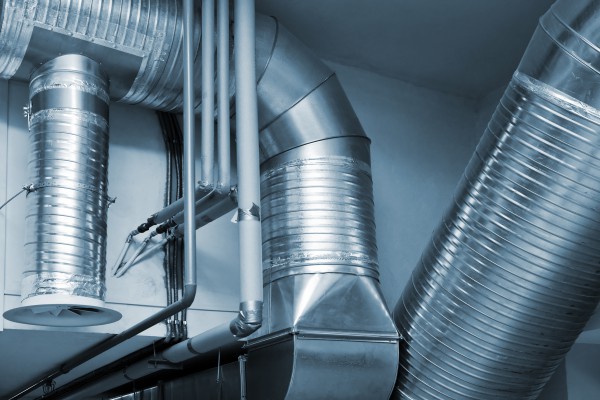
Duct leakage testing seals off a section of ductwork, pressurizes it with a calibrated fan, and measures how much air escapes — comparing the result against the project's allowable SMACNA leakage class. dL Flow Tech is an independent, NEBB-certified firm that has performed commercial duct leakage testing across the Hudson Valley since 1982, documenting results in a report the engineer of record can accept.
Get a duct leakage testing quote: Call (845) 265-2828 or send your drawings and specs for a fixed-scope proposal.
What is duct leakage testing?
Duct leakage testing is a measured verification of how air-tight a duct system is. A defined section of ductwork is sealed, pressurized to a specified test pressure with a calibrated duct-leakage tester, and the volume of air needed to hold that pressure is recorded as the leakage rate. That rate is compared to the maximum the specification allows — usually expressed as a SMACNA leakage class — and the section either passes or gets sealed and retested.
It answers a question the drawings can't: does the duct that got installed actually hold the air it's supposed to carry? A system can pass a visual inspection and still bleed a large fraction of its airflow into ceiling plenums and shafts before it ever reaches an occupied room. Testing puts a number on it.
Why duct leakage testing matters
- Wasted fan energy. Air that leaks out of the supply ductwork still had to be moved by the fan. A system leaking 15–20% is running its fan that much harder for air that never conditions a room.
- Airflow that never arrives. Leakage upstream means the diffusers at the end of the run can't deliver design airflow no matter how the system is balanced. Leakage and balancing are linked — you can't balance your way out of a duct that's losing air.
- Lost pressurization. In healthcare, labs, and cleanrooms, duct leakage undermines the room-pressure relationships that keep contaminants where they belong.
- Code and certification. Energy codes require duct sealing and, increasingly, testing to prove it. Specifications on commercial and institutional projects frequently call for a documented leakage test before the system is accepted.
- Comfort and IAQ. Conditioned air dumped into a ceiling plenum is air not delivered to people. Leakage shows up downstream as rooms that won't hold temperature.
Testing early — before ductwork is concealed above hard ceilings or inside shafts — is what makes leaks cheap to fix. Found late, the same leak is behind drywall.
SMACNA leakage classes and allowable leakage
Commercial duct leakage testing is governed by SMACNA's HVAC Air Duct Leakage Test Manual. SMACNA assigns a leakage class based on duct construction, sealing, and operating pressure — the tighter the class, the less leakage allowed per unit of duct surface. The allowable leakage for a section is a function of that class, the duct's surface area, and the static pressure it's tested at, so a low-pressure return and a high-pressure supply main are held to different standards by design.
The specification or energy code sets the target class; we test the duct at its design pressure and the measured leakage either falls within the allowable for that class or it doesn't. We document the inputs and the result so the number is defensible.
How we test for duct leakage
- Plan the sections with the contractor. We coordinate which duct sections get tested and when, so testing happens while the ductwork is still accessible.
- Isolate and seal the section. The section under test is capped at its boundaries so the only path for air is through actual leaks in the duct.
- Pressurize to test pressure. We connect the calibrated duct-leakage tester and bring the section up to its specified test pressure.
- Measure and record. We read the leakage airflow directly from the calibrated flow meter, and capture the test pressure and duct surface area needed to evaluate against the SMACNA class.
- Document the result. Each section's test pressure, surface area, measured leakage, allowable leakage, and pass/fail margin go into the report. If a section fails, the contractor seals and we retest.
Duct leakage testing vs. blower door testing
Duct leakage testing measures how much air escapes the ductwork. Blower door testing measures how much air leaks through the building envelope. A building can have tight ducts and a leaky envelope, or the reverse. Many commissioning scopes call for both; they answer different questions and neither substitutes for the other.
What your duct leakage testing report contains
A complete dL Flow Tech duct leakage report includes the instrument list with calibration dates, a clear identification of each section tested and its boundaries, the test pressure applied, the duct surface area evaluated, the measured leakage and the allowable leakage for the specified SMACNA class, the pass/fail margin for each section, and a signed certification.
Service area
dL Flow Tech performs duct leakage testing from New York City north through the Hudson Valley to Albany — Dutchess, Westchester, Orange, Putnam, Rockland, and Ulster counties, the five boroughs, and the Capital Region. See our service-area pages for detail.
Have a leakage spec to satisfy? Call (845) 265-2828 or send your project documents and we'll quote the testing scope.
Frequently asked questions
- How much does duct leakage testing cost?
- It's quoted per project — price depends on how many sections need testing, the duct pressure class, and the construction sequence. Send the mechanical drawings and the spec section that calls for testing and we'll return a fixed-scope proposal.
- What is an acceptable duct leakage rate?
- There's no single universal number. The allowable leakage is set by the SMACNA leakage class in your specification, applied to the duct's surface area and test pressure. Tighter classes allow less leakage and are used on higher-pressure, more critical ductwork.
- When should ductwork be tested — before or after it's concealed?
- Before. Testing while the ductwork is still accessible means any failing section can be located and sealed without opening up finished ceilings or shafts. We coordinate the testing schedule with the contractor for exactly this reason.
- Is duct leakage testing the same as a blower door test?
- No. Duct leakage testing measures air escaping the ductwork; a blower door test measures air leaking through the building envelope. They're different tests, and many projects need both.
- Do you have to test all the ductwork, or just a sample?
- It depends on the specification. Some specs require testing all ductwork above a certain pressure; others require a representative sample. We follow what your spec calls for and document exactly which sections were tested.